Expert Guide: Choosing the Right Mainsail Handling System for Performance and Control
Introduction
For performance cruisers, offshore sailors, and serious racers, mainsail handling systems are not just about convenience—they’re integral to safety, sail efficiency, and control under varying conditions. In this guide, we’ll explore the pros, limitations, and technical nuances of advanced mainsail handling solutions, with a focus on system compatibility, sail shape preservation, and long-term durability.
Lazy Jacks (High-Modulus Options & Custom Layouts)
Lazy jacks remain the go-to for simplicity and fail-safe operation. High-performance setups often feature low-stretch Dyneema lines, custom spacing, and boom-length-specific designs.
Pros:
- No moving parts; minimal failure points
- Supports offshore redundancy
- Fully compatible with full-batten sails
Cons:
- Can interfere with hoisting (especially roachy mainsails)
- Chafe potential on Dacron and laminated sails
Expert Tip: Specify soft-coated Dyneema or UHMWPE with abrasion sleeves where the lines contact the sail. Add cam cleats at the mast base for easy tensioning.

Stack Pack / Integrated Boom Bags
Combines lazy jacks with a boom-mounted sail bag like Ullman Sails UStack—often custom-fit to the sail and boom. Top choices use UV-treated acrylic or Weathermax with internal battens.
Pros:
- Instant sail storage on drop
- Reduces UV damage and handling time
- Can be semi-permanent or zip-off
Cons:
- Added windage
- Must be tailored to avoid flogging or water retention
Expert Tip: Specify hard battens along the cover top edge and reinforcement at attachment points. Avoid loose-fit off-the-shelf kits for offshore boats.
Dutchman System
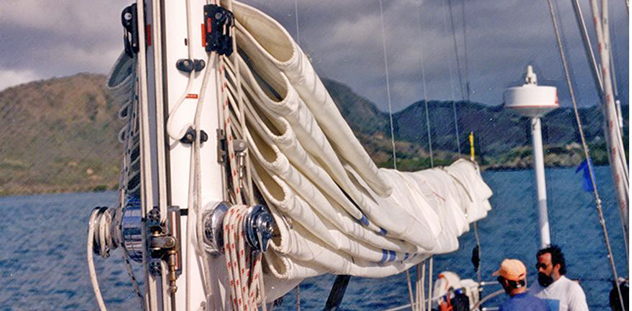
The Dutchman uses vertical monofilament lines (usually Spectra) passing through sail slots, controlled from the topping lift, to guide flaking.
Pros:
- Automatic flaking into tight stacks
- Clean, uncluttered boom area
- Compatible with full battens and batcars
Cons:
- Precision install required—sail slots must align precisely
- Tuning tension critical; failure leads to misflaking or sail damage
Expert Tip: Best performance comes from factory-installed systems with sails built specifically for Dutchman integration. Avoid retrofit kits on older mains.
In-Boom Furling (LeisureFurl, Forespar, Offshore Spars)
Allows for full-batten sails with vertical battens and high-roach profiles to furl horizontally inside a custom boom extrusion.
Pros:
- Preserves sail shape and performance
- Infinite reef points
- Safer reefing from cockpit
Cons:
- Requires careful alignment and halyard tension
- Furling angle critical—improper technique leads to jams
- Higher weight aloft and cost
Expert Tip: Install a halyard lock or load-sensing clutch to maintain precise halyard tension during furl.
In-Mast Furling (Selden, Sparcraft, Z-Spar)
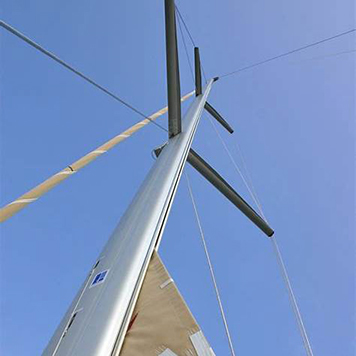
The mainsail furls vertically into the mast, using either manual or powered (electric/hydraulic) drives.
Pros:
- Effortless furl and reefing from cockpit
- Ideal for shorthanded cruising
- Low boom height improves safety
Cons:
- Flat-cut sail only—limited roach and shape
- Inaccessible if jammed
- Heavier mast section
Expert Tip: Choose vertical battens only if the system is engineered for them. Work with a sailmaker to optimize batten spacing and foot shape for consistent furling.
Conclusion
The right mainsail handling system blends functionality, reliability, and performance. For bluewater cruisers and racers alike, investing in the correct combination of sail hardware, furling or flaking system, and proper sail design will pay off in safer, smoother passages.